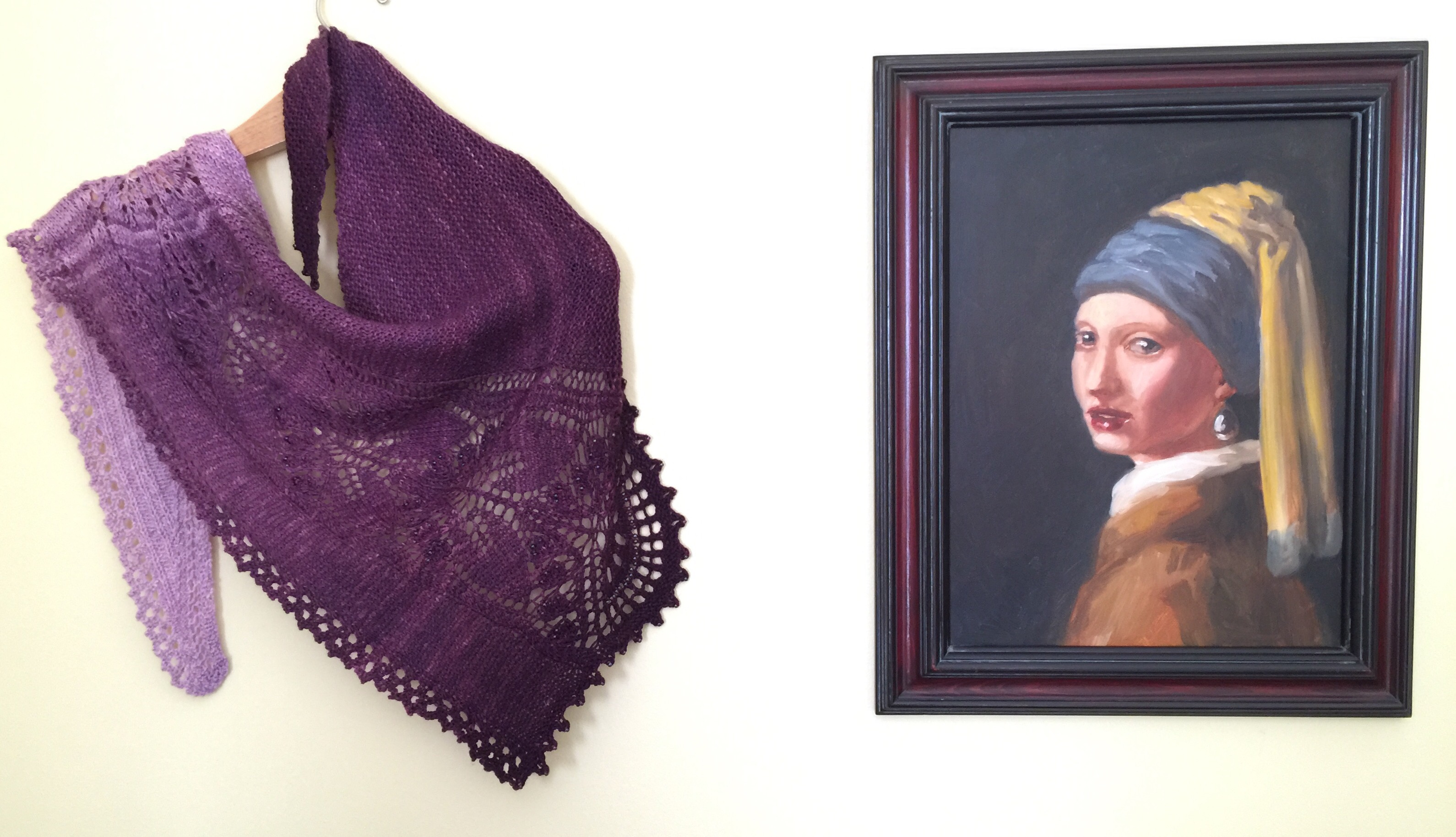
Detained in East Berlin

I began to write this some months ago, but sometimes things are just difficult to revisit. Not much more than the title and the link to my trip theme song sat in my drafts folder in all that time. Spring cleaning season, I have to either finish this or delete it. I went back and reread emails I had sent to friends during this time to help recall all the details in my attempt to write this. It is still a struggle. “Once more unto the breach, dear friends, once more” (William Shakespeare, Henry V

Theme Song for a Travel Adventure

Often things do not go as planned while on travel. When the unexpected happens it can lead to unique and memorable travel experiences. Often though, the most interesting travel stories are the hardest to experience. The reward for surviving a bad travel derailment is a good story to tell; a story of unexpected circumstances, obstacles to overcome, and the heroes and villains who helped or hindered the journey.

Pharmacies in European countries tend to be knowledgable and helpful, they are usually staffed with pharmacists who have enough English fluency to understand the issue and make the appropriate suggestions. They certainly can address the usual travelers’ problems of digestive disruptions,  jet lag induced cold viruses, foot blisters, and even the occasional welts from insect bites. My international medical care has been that little cross sign, sometimes green, sometimes blue, sometimes red, but whatever the color, that sign lights the way to relief. Until this trip.

We had arrived in Berlin on a very early Saturday morning and checked into our apartment. The apartment was centrally located by the U-bahn and tram lines, which was great for getting about but not so good for the sleeping through the night-long commotion. Sirens went off all hours of the night, trams rumbled by, and even 6 floors up we heard crowds of jubilant people going by on the weekends. By Monday evening I had a sore throat that progressively got worse day-by-day but had no other symptoms: no fever, no fatigue, no stuffiness, just a sore throat. Other than visiting the pharmacy for progressively stronger throat lozenges, I pretty much just carried on. Thursday night I developed conjunctivitis and on Friday night, as I was walking home from dinner, suddenly–and without warning–my ear felt stopped up and painful. In the night amidst snap, crackle, and pop fluid began to drain out. A ruptured eardrum without even having a cold? I had heard of precision crafted German driving machines, but this powerful German crafted virus was a first.

My second Saturday was a tour of clinics with my daughter, and thank goodness for her. I would have been completely lost without her translating skills in both the language and the culture. We went to a clinic that she knew would be open on Saturday, and they were, but they would not see me because they did not have the specialists to treat my symptoms. They sent us to a hospital on the other side of Berlin which, with transfers, would be an estimated 40 minute tram ride. I had withdrawn 300 Euro for medical expenses, so with all that Euro in my pocket we decided to splurge on a taxi rather than negotiate trams.

When we arrived at the hospital clinic, not easily found on a huge campus, we waited our turn to check in with the receptionist. After only a few minutes wait, I was relieved to find she spoke some English. Between my daughters German skills and the receptionist’s English, we were able to communicate. They would see me for a prepayment of 300 Euro. I did not have 300 Euro, I had 300 Euro minus taxi fare. When she gave me the option of 100 Euro on a credit card, offering that option as if it were a bad thing as compared to paying cash, I whipped out my Visa, failing to show any reluctance to use a card over cash. With a 100 Euro prepay on a credit card, a scan of my passport, a scan of my insurance card, and my daughters local address for any additional billing, a flurry of papers were printed, stamped, and inserted into a folder. We had our ticket for admission.

We were told to go to another area and hand the folder to a nurse. The clinic area was a confusing sea of people but we quickly realized that nurses were identifiable by their blue uniforms. None of the nurses spoke any English. My daughter cornered one, handed him the folder, and they spoke at length while I stared uncomprehendingly. When they finished, my daughter guided me to the waiting area and told me to get comfortable. As the other clinic had said, I would need to see different doctors for my eyes and ears, neither of which were at the clinic but were on their way.  There were about 10 people ahead of us and they estimated a 3 hour wait. With that much time stretching before us, my daughter left the mobile phone restricted area to make a call. Fortunately, it was not as long of a wait as three hours, and even more fortunately my daughter returned moments before they called my name. Even if I had recognized my name as pronounced in German, which I did not, I would have found all subsequent directions incomprehensible.

We saw the eye doctor first, a very kind young woman with very good English. She gave me a complete eye exam including vision and pressure exams. She pronounced a virus but gave me a prescription for antibiotic drops, drops to reduce the irritation, and orders to go out and enjoy Berlin as I felt up to it. Then it was back to the waiting room for doctor number two.

Doctor number two. She had her back to us as we entered, turned around suddenly and in a clipped voice said, “I am Doctor so-und-so, what is your problem?” A little intimidated, I meekly gave her my rundown of woes while she roughly poked and prodded with no warning as to what she was going to do. She jammed a metal tongue depressor into my mouth so far back and so suddenly that I gagged. And can I tell you how high I jumped when she unexpectedly stuck some sort of vacuum contraption in my ear and turned it on without warning on my inflamed eardrum? Then I mentioned I was flying home on Monday. Without hesitation, she proclaimed “No! No flying. You do not fly for two weeks.” My daughter and I had a look of horror on our faces. Two weeks. It did not seem likely we would have a pleasant doctor-patient discussion, but nevertheless we did try. She would not rescind her no fly order but eventually did say 1 week if I get clearance from an ENT. She wrote out scripts for Amoxicillin, a high dosage ibuprofen, and nose spray along with the diagnosis and a no-fly order for the airline.

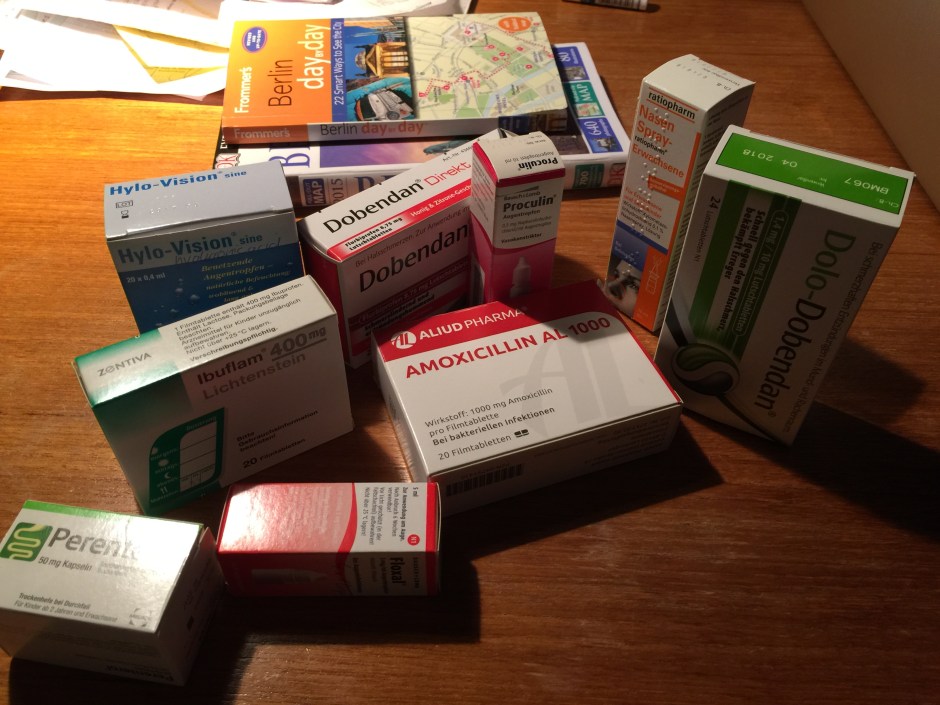
In Germany, pharmacies close at 2:00 pm (or 14:00 as they say in Europe) on Saturday and do not reopen until Monday. At this point, it was about 2:30 and I had a fist full of prescriptions from the two doctors. The hospital staff knew of one “after hours” pharmacy at the Hauptbanhoff, the main train station, on the other side of town. Once again we dipped into the stash of Euro and ordered a cab. At the train station I got my fistful of prescriptions filled and, along with some probiotics, a hot water bottle for comfort, and silicone earplugs to keep water out of my ear in the shower, the total came to 106 euro for the 5 prescriptions and extras, payable on a credit card. It gave me hope that the final clinic charges would be as reasonable as the pharmacy’s.

We finally collapsed in a Vietnamese restaurant about 4:00 (16:00) to have a comforting noodle soup for lunch. Only then did we attempt to track down the spouse and deliver the news that I could not fly home on Monday. He had been at a Greek restaurant that afternoon where they had dropped a glass full of ouzo in front of him and had refilled it at every opportunity. We were grateful for those generous pours of ouzo for when he came to join us he took the news quite well. As my return was so uncertain, we decided that he would fly home on Monday as scheduled and I would follow as soon as I able.

I had no worries about the return, I had purchased insurance. But nothing is ever that easy. Even with a no-fly note from the doctor, Air Berlin would not change my return. I could cancel and apply to the insurance for the balance of the unused portion of the ticket, but a return would involve booking a brand new reservation at current (last-minute) costs. If I had to change again, which was a distinct possibility, it would be rinse and repeat. All this was related to me by an unsympathetic and officious Air Berlin Agent. Fortunately, I had miles on United and was able to bypass Air Berlin and book a return on Lufthansa 10 days after my originally scheduled flight, splitting the difference between 1-2 weeks. Just to be sure, I purchased travel insurance in case that ten days out Tuesday was too soon.

The apartment owner was very kind;  I could stay in the apartment until the following Thursday morning, but another group was arriving so I had to find another place to stay. At my landlord’s suggestion I checked  Home Away and my daughter checked Air B&B, eventually we found another place to stay on nearby Schönhauser Allee. My daughter and her German (and German-speaking) boyfriend talked to various doctors offices and found an ENT who would agree to see me in spite of not having German health insurance. Once again, her having a local address (and fluency) saved my bacon. For the most part, everything had fallen into place.
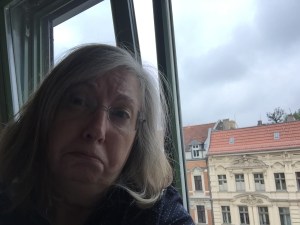
imageMonday morning early the spouse boarded a cab for the airport, shutting the door on his vacation and leaving me behind in an empty apartment. Meanwhile, my daughter had put off all her appointments and responsibilities the prior week for her parents’ visit. She had no time during my additional days and, other than a couple of late afternoon outings, we saw each other every evening for dinner, and sometimes even that was rushed. I am fine spending time on my own, and even traveling on my own. However, I was completely deaf in my left ear and it was very disorienting trying to interpret sound.  I was fine in a quiet environment but when I went out amidst the traffic and city noise my brain had trouble processing the sounds, it was all a dizzying auditory confusion. Not that I could understand German any better with two ears, but the city noise itself was an incomprehensible jumble. Other than the times I went out with my daughter I spent quiet time indoors, reading, knitting, and resting. I always pack enough yarn and projects to outlast a zombie apocalypse, but this time I did so much knitting that even I had to buy more yarn.

Although I had packed for the forecasted mild weather, I had thrown in a wool jacket and a couple of light shawls as an afterthought. By now the weather had turned from temperate autumn to pre-winter chill. I had to buy hat and gloves but otherwise managed in spite of packing for warmer temperatures. The first apartment had a washing machine and I could wash my just-a-short-trip supply of clothes, giving me more use out of what I had brought. My resources were a very tiny washing  machine and a drying rack; it took a few days to get through my suitcase of warmer weather clothes but in addition to getting something unseasonable but clean to wear it gave me something productive to do while serving my sentence of solitary confinement.

My most difficult day was Thursday when I had to change lodgings.

On Thursday I had to check out of the first apartment, cross town to see the ENT Doctor, and check in to the next apartment with nothing timed to do any of that smoothly. My landlord kindly offered to hold my luggage and to let me stay until it was time for my daughter to pick me up for the doctor, well past the usual check out time. The new place could not let me in until late afternoon, although my daughter arranged to meet the agent earlier to pick up the keys and drop my luggage, I would be homeless from the moment I checked out until late afternoon.

The staff at the doctor’s office spoke only German but the ENT spoke English fluently. She was very nice when she delivered more bad news. I could not be released to fly for several weeks unless I got an eryngotomy–a procedure to open the eardrum and release the pressure–and flew within 72 hours of the procedure. She could schedule it at the earliest the following Tuesday. Tuesday, the day I was scheduled to check out of my second apartment and fly home. Once again, I would have to change return reservations and find a place to stay.

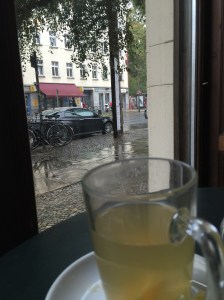
We had lunch, returned to apartment number one, picked up the luggage, went to apartment number two, dropped off the luggage, went to a cafe around the corner from the new apartment, and I bid my daughter goodbye as she rushed off to another appointment. Deposited at a table by the window with a cup of ginger tea, I was left onimage my own. With more than two hours before I could get into the apartment, I sat a solitary figure as rain fell from gray skies, hearing little and unable to understand what little I did, drinking the cup of tea slowly to fill the time. I had no internet access in the cafe and, although would be anxious until it was sorted out, had no means to undo and redo my travel arrangements. It was a very sad and lonely moment, a moment in which I could have let the wave of self-pity wash over me and carry me away. About an hour in, I gathered myself–stepping out of the wave of self pity that had by now had reached past my ankles–and found a local grocery store to buy supplies for my lunches, breakfasts, and tea times. Comforted by doing this small action, I walked slowly towards the apartment in hopes that I could settle into my new place when I arrived. The key turned in the lock, the apartment was silent, cold, and empty but ready for occupancy. The Internet was working and my devices connected as I walked through the door.
When we had dropped the luggage and picked up the keys, on the pretense of making sure I could connect with the Internet, I had connected and quickly sent an email to the manager asking if I could add an extra day’s stay. We could not stay to get an answer but a positive response awaited me when I returned and opened my email. Accommodations were now taken care of but flight reservations were not quite so painless.

Now less than a week away, the number of miles needed for flying on Wednesday had skyrocketed. Phone calls on my international plan are very expensive, so I rang the stateside spouse on FaceTime and asked him call United to see if there were any other options. His response? “I can’t do it right now, I have an appointment for a massage.” Such are the perils of remote communication, he, keys in hand, ready to head out the door, mind on his mission, and caught unexpectedly by a ringing phone; unaware of my internet-less gray-skied ginger tea afternoon with the many hours of disruption, uncertainty, and isolation all the while unable to take action and fighting back self pity. Although not at the forefront of my thoughts and feelings, a low hum in the back of my mind looped the fear of the upcoming and intrusive medical procedure. He, in his on-the-way-to-somewhere state of mind, did not know anything of my day.  Still, hearing, “I am late for a meeting” would have been a less bitter pill to swallow than something about a massage in the midst of that difficult day. Speechless, I disconnected while I still had a small fragment of stretched nerve intact to stave off a meltdown.

Inhale. Exhale. Think.

To solve the phone problem, I put funds into my Skype account so I could call a landline number. I crossed my fingers, took a deep breath, and called United. It worked. In that cold, rainy, nightmarish, all alone moment, I reached the kindest and most helpful person at United reservations. There is nothing quite like finding kindness when all you expect is indifference, especially at a moment when it is as welcome as it is needed. I watched the minutes tick by–all the while hoping my Skype would not run out of funds and disconnect me–but she stayed with me through exploring options, connecting with the frequent flyer desk to cancel the Tuesday reservation and redeposit the miles, and finally withdrawing the miles and funds needed for booking the new flights. Another $25 fee and more miles, but she booked me on a Business Class flight through Munich on Lufthansa for the following Wednesday, a flight that left Berlin at a reasonable hour and reached Chicago early evening. Someone had an appointment for a message, and I had a reservation for business class.

After spending most of the day without having internet to update my reservations, only to be told to wait still more hours when asking for help, I had finally resolved the final piece of the puzzle with the help of an unlikely stranger. Relieved, I brewed a cup of tea and selfishly ate a good portion of the cookies from Vienna that my daughter’s boyfriend had brought back for us to share, enjoying every bite. Thoroughly relaxed by now, I emailed the reservation details to my family. The spouse initially responded with a couldn’t-you-get-something-that-arrives-earlier-in-the-day response but he rose in my estimation by following up with a suggestion that we book a hotel by the airport. After my arrival we could have dinner, rest up, and make the long drive back home in the morning. He also came through by booking a local ENT follow up appointment for me on Thursday afternoon. Thankfully, I had not eaten all the cookies and he was duly rewarded with their crunchy goodness and my appreciation.

Although most of my remaining days in Berlin were spent on my own, and mostly in the apartment, my daughter and I did get some “bonus time” together. I did what I could to not be an imposition while she fretted and felt badly about leaving me, but she had so much to catch up with and I was completely sympathetic. In truth, the quiet time to rest and recuperate was probably for the best. But when we could get together it was very nice. It is so rare that it is just the two of us. Our outings together were special moments that I will remember fondly, the happy outcome in spite of all the rest.

My daughter picked me up and went with me when I got the procedure on Tuesday. She had a calm, stoic demeanor but the grip she had on my hand betrayed her fear for me when the doctor began the procedure. It sounded awful to get my eardrum opened but really the worst of it was the injections of Novocain into the ear. Not only did I get a feeling of relief but I also regained some hearing. It was not so very bad. Still, to have it over and done with, and to be able to hear again, was a great relief. The long journey home was ahead of me–and it would not be easy–but I was released and free to go. The doctor told me to keep the ear open by periodically plugging my mouth and nose and blowing, which created the oddest feeling and the weirdest noise imaginable, something like a kazoo I was told. The noise must have bewildered fellow passengers, but I followed orders and subjected them to it.

Thankfully the journey home was uneventful. My daughter stayed at my apartment the final night and came with me to the airport to get checked in. I was so nervous about the flights, and it was uncomfortable but I made it through. A doctor friend recommended chewing GoldFish crackers for take-offs and landings; swallowing while eating opens up the ears better than chewing gum apparently. I found some tiny bio German crackers to substitute for the GoldFish and faithfully nibbled them for all ups and downs. Playing my built-in kazoo helped when the pressure became too much.

Staying at a local hotel was a great idea. I was so stressed about take-offs and landings that I had barely enough energy to collect my bags and negotiate customs, it was time to put an end to the day. By the time we checked in nothing sounded better than a shower and a warm bed and the spouse did not have to turn around and drive another 2-1/2 hours after having driven up to the airport; it was a good plan and worth every penny.

With a good night’s sleep behind me, a follow-up with an ENT in front of me, we at last loaded the car with out of season clothes and headed for home, back to Wenig Haus auf der Prärie, the Little House on the Prairie.

Memorable Meals: The Weight of a Magnum

imageOne of our favorite Bay Area events was the Santa Cruz Mountains Wine Weekends, the purchase of one wine glass was the ticket to wineries on the Bay side of the Santa Cruz Mountains the first weekend and the ocean side the second. The bay side was convenient to us and we had relatives to stay with on the ocean side, so the purchase of one glass was a ticket to a lot of wines.

Many of the wineries are in remote and difficult to get to locations, often groups of wineries would set up tasting tables at a single venue. The normal tasting routine was to start with the light wines, move through the whites from light and dry to rich and full, continue with the lighter bodied reds, and finish off with the full-bodied, barn-burner reds. Not a bad plan for a single tasting, or a tasting that is a 20 minute drive from the previous one, but when there are about 4 or 5 wineries all operating from the light to the dark side, the taste buds can go from discriminating to full confusion. It occurs to me now that the best thing would have been to make a complete wine #1 circuit, a wine #2 circuit, and so on in order for my taste buds to compare pleasantly light to pleasantly light and intensely rich to intense rich. For whatever reason–not that all those sips of wine would effect our reason–that did not occur to us at the time. We would go home with lots of bottles that we thought were fabulous at the time; months later they were opened in hopes that our cloudy purchase decisions were good ones. Happily, we were never disappointed nor were we ever plagued with buyer’s regret.

At one of these venues there were crowds gathered around every tasting table. One was a little less crowded than the others and, without the pressure of frantic rounds of pouring and recitations of wine facts, I was able to chat with the winemaker a bit. They were just starting out–which explained the smaller crowd–and had a wine club that promised to have special events and privileges for its first 100 members. I like privileges in this voice-activated, please-listen-as-our-options-have-changed, customer service-avoidance world, but the costs of shipping wine can exceed the costs of the wines so I was hesitant. I thought about it as I went to the other tables and sipped my way through series of light transparent whites to deep opaque reds. I returned after having made my circuit and, before 100 people could beat me to it, signed on the dotted line. My final resistance gave way when they told me they would arrange to have the winery open to the public when the club wines were released. The winery was located about 40 minutes from our home; picnicking in a pretty winery a few times a year sounded lovely. I managed to beat 93 people, becoming lucky member number 7. In the months and years that followed, hundreds more joined and we all were equally loved, but in the beginning we were special being there at the start.

They were as good as their word, having wonderful member events and occasions to celebrate the wineries climb to recognition and accolades. Wine pick-ups were a day’s outing not only for us but also for our resident energetic and friendly border collie. He would sleep in the back seat on our way down, but as soon as we pulled off the freeway and made our way to the country roads, he would pop up, stick his snoot out the window, and breath in the scents of dry California grasses baking on the hillsides. Upon arrival, our routine was to hop out of the car and go straight to the pond for a lap around water and grapevines before going to the winery. On one of our visits there was an event and a drawing for prizes. We had finished our lunch and were doing another pond circuit before our drive home. When we returned to gather our things, someone said, “You won!” We had to be present to win but as they thought we were still on the property had held off drawing another name. Sure enough, we won the grand prize: a magnum of Cabernet Franc.

We learned a bit more about this wine. They were just returning from losing a beloved pet and the phone was ringing as they entered the house. It was a reporter wanting to buy several cases of their Cabernet Franc. This was how–in a low moment–they heard the happy news that they had won their first gold metal. The wine sold out very quickly and this magnum was one of the few remaining bottles. Somehow, my thrill of winning became my weight of responsibility. This wine deserved more than being opened amidst a large party, fated to be poured into plastic tumblers and left forgotten on side tables. It was a weighty challenge to find an occasion worthy of the wine.

After discussing various possibilities, we reached a decision; we would have a dinner that included only people who would appreciate a special wine highlighted by good food and company. The first guests we thought of were the winemakers themselves, and they graciously accepted. Rounding out the party were friends of ours who had taken several cooking classes and enjoyed gourmet cooking along with a couple of family members. Guests to gather round the table determined, the next weighty challenge was what to put on the table to compliment and honor the wine.

Around this time a rather short lived but wonderful dining opportunity came into being. A French chef, a Maîtres Cuisiniers de France and former Culinary Acadmey instructor, started offering a dinner once a week in his friend’s little breakfast and lunch cafe. It was reservations only, set seating times, BYOB, and prix fix menus, but for those of us who were lucky enough to find out about it, and even luckier to get a table, it was a slow-paced, multi-coursed evening of great food. The small cafe was dressed up for evening with Provençal tablecloths, candles, and china place settings. Diners often sipped their wine and chatted amongst themselves while patiently waiting for each course. At the end of one such evening, having finished the cheese course and trying to work our way through a decadent dessert, the chef came out and chatted with the well-sipped and over-fed diners. The conversation turned to wine and I naturally mentioned my magnum and food pairing conundrum. The chef had all sorts of suggestions and–all those sips of wine between courses may have had something to do with this–I invited him to join us.

So now we had a French chef and his family, gold medal winning winemakers, foodie friends, and a few assorted family members, specifically my mother, daughter, and spouse. No pressure, just the usual dinner party.

The day of the dinner, my mother, daughter, and I spent all afternoon chopping onions, grinding spices, and braising lamb shanks. We used a recipe of Jamie Oliver’s, “Spiced Slow-Cooked Lamb Shanks” from The Naked Chef. The irony of using a recipe from a British Chef’s cookbook to serve a French chef was not lost on me, but I knew imagethis recipe. A braise is usually satisfyingly rich and, more importantly, very forgiving. In an unorthodox move, I made a mass of polenta in a fuzzy logic rice cooker, but I needed a way to keep it hot and moist for an undertimined amount of time and fortunately it worked like a charm. We scurried about, sweated cucumber slices, spread them with goat cheese, and topped them with smoked salmon and a sprig of dill, moved furniture into place and laid the table, made last minute salads, and moments before guests arrived sliced up baguettes. We, three generations of women, worked all afternoon without a snip or a snarl.

Our gourmet friends arrived with chocolate pots de creme, our winemakers with more wine and winery stemware to serve it in, and our chef and family with duck legs ready to be finished in the oven. It required emptying the liquor cabinet before finding something suitable for flaming into glazing sauce, adding to the kitchen chaos, but soon duck legs were glazed and golden.

Before the preliminary sips, nibbles, and salad had been consumed, the group was relaxed and chatting like old friends. Our winemaker opened the magnum of Cabernet Franc and while he did the ceremonial pouring, the main course was served to honor the star of the show. British Jamie Oliver’s lamb shanks valiantly stood along side a French chef’s duck and a California gold medal wine. Even the polenta was a success, the chef’s son was a picky eater and he filled his mostly empty plate with several helpings of polenta. Wine enjoyed and consumed, dinner eaten, and plates cleared, we finished with the decadent chocolate. The evening had been enjoyed and had come to a satisfying end.

It was nerve wracking to cook for that particular group, but looking back it was worth every moment of worry and ranks among one of our most memorable meals. Whether anyone thought the food we prepared was worthy of the wine I will never know, they were too polite to say anything other than the usual complimentary remarks. But I truly believe the winemakers recognized our efforts to honor the wine and appreciated being present for the sharing of it. Our friends and our family love us for who we are, not for what we cook, but they all genuinely seemed to enjoy the food, wine, and company. As to the chef? What mattered was not the food served but the invitation given. Perhaps because it is so intimidating, an accomplished chef gets few invitations to eat in ordinary homes. He too recognized our effort and forgave our amateurish kitchen skills in exchange for the opportunity to just be a guest. Besides, this time the taste bud confusion of so many wines worked in our favor. If enough wine is poured, everything tastes great. And in my memory, it did.

Memorable Meals: Thanksgiving on Île de la Cité

As mentioned in the Thrill is Gone, I am temporarily restricted to a bland diet and determined to soldier through to better days. In the meantime, while I may not be able to indulge, my memory is free to enjoy memorable meals of the past. One of our memorable meals was a Franco-American Thanksgiving on Île de la Cité.

Traveling in November is a roll of the dice, but if our number comes up it is a great time to visit Europe; the sites, museums, and restaurants are a bit less crowded and everything a lot quieter and peaceful in the soft winter light. A bit risky, but it can be a wonderful time to travel if Momma Nature and the Travel Gods are on our side. While late November can be one of the busiest travel times of the year in the states, Thanksgiving is virtually unknown in Europe save for ex-pats and the people who are lucky enough to befriend them. Likewise with shopping in November, no crowds before Thanksgiving rushing to markets and grocers, no crowds after Thanksgiving sprinting full speed ahead into the Christmas rush. It is a quiet time in Europe, a bit before the Christmas markets open and long after the summer tourists have returned home.

One November we joined with friends and found a wonderful apartment on Île de la Cité overlooking the busy Seine and Hôtel de Ville. Centered in the middle of the most touristy of Paris, we had wonderful places to explore in all directions–and we did–but one of our favorite things was to sit at the window and watch the boats go by from the early morning commercial river traffic to the busy tourist boats that drifted by throughout the day, the dusk, and into the twinkling lit darkness of evening. It was the perfect place to take a break for lunch in the middle of the day, we were never far from our local home for a simple luncheon with a remarkable view.

The kitchen was small but our dining table was quite large, a bit challenging for cooking but a perfect place for entertaining. With plenty of seating at the table we were able to increase our number with an assortment of guests, our nephew who was studying in Paris that year, our daughter and her British friend who joined us from Germany, and finally a chef acquaintance of our friends, who happened to be in Paris with his daughter and a friend, completed the guest list.

With a challenging kitchen–very limited counter space, tiny refrigerator, and a small oven–we had to plan our feast accordingly. We were familiar with the local wine, produce, butcher, and cheese shops in the neighborhood but we needed more selection than could be found in our immediate area to create a Thanksgiving. We branched out to other neighborhoods looking for oddities.

Not trusting I could find canned pumpkin and condensed milk in Paris, I brought a couple of cans with me along with some decent knives; one is less likely to find good knives in a rental apartment than cans of Libby’s pumpkin in Paris. Not surprisingly, the kitchen–although fairly well outfitted–did not have pie pans. No problem, we were across from a large BHV department store and not too far away from cookware shops in Les Halles.

We found fabulous cookware and housewares departments in the BHV, and did pick up a few things, but not pie pans. To say we picked up a few things fails to relate how perplexed we were shopping in this store. We had a total failure to communicate, and not just with the language. We gathered our goods and stood in line for the cashier waiting to check out. When we reached the front of the line, the woman would not ring up our purchases. Our French was not good enough to gather more than the emphatic “No” and we were quite at a loss as to why she refused to sell us the items we had gathered. It was not until we found a salesperson on the floor who had enough English to explain the proper way to purchase our goods that we were able to have any success. Our instructions were to leave the goods in the department, have a salesperson on the floor write a ticket, take the ticket to the cashier, stand in line (again), pay the amount on the ticket, have the ticket marked as paid, return to the department where the goods remained on the shelves, find the salesperson and give him or her the ticket, wait patiently as he or she collected the goods and wrapped them for carry-out, and finally, after all that, would we be able to leave with the goods.

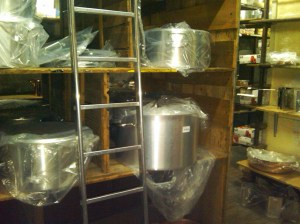
We wandered through a cookware shop with a large baking section in Les Halles, but no pie pan. Surely, we thought, the very famous Julia Child recommended shop, E.Dehillerin, would have pie pans. E.Dehillerin did have about every type of cookware and bakeware one could imagine, including pots big enough to seat all of our guests, but no pie pans. It was a multi-level, floor to ceiling treasure hunt that turned up many a treasure save the one we were looking for. Sighing with the thought of all those disposable aluminum pie tins hanging in displays in the states, I belatedly thought how easily a couple of aluminum pie tins could have joined my cans for the transatlantic journey. Well, this was Paris so citrouille tarte it would be.

image
E. Dehillerin

Having resolved to make a tart and giving up the pie pan search, I realized we that while we had a tart pan we had no pastry making equipment. We would not mind searching  La Grande Épicerie de Paris for pre made tart shells but were fortunate to find a smallish supermarket nearby that had “bio” savory tart pastry in a roll, similar to the Pillsbury pie crusts found in the refrigerated section in grocery stores at home but made from all natural ingredients. It was pretty close to as good as we could have made if we had counter space, pastry boards, mixing bowls, and rolling pins. Heavy cream, no problem. Our plans and ingredients for pumpkin pie, or rather tart, all present and accounted for.

The produce store nearby was good but selected our produce for us, it was strictly hands-off and all transactions took place in French or by pointing and holding up fingers; a bit difficult when one has limited French and a long list of produce to purchase. The first time in the shop I had learned the moment my fingers reached for a tangerine that I had done the unthinkable. My husband entered a few minutes later and began to reach for a piece of fruit and I cried, “NOOOOO, don’t touch it!” just in time to prevent another international incident. The produce store we found in Saint Germain was a bit more relaxed and we could select on our own produce or get assistance. There we found a bag of Ocean Spray fresh cranberries and as soon as I had them in hand, an assistant was by my side helping me find everything on my laboriously translated-into-French shopping list. He even asked how many stalks of celery we needed for our stuffing and tore off just the amount we needed, no leftovers to worry about shoving into that tiny refrigerator. Sage was the problem as my translator had given me the translation for a wise guy, not an herb, but he stuck with me until we figured it out and we eventually found it.

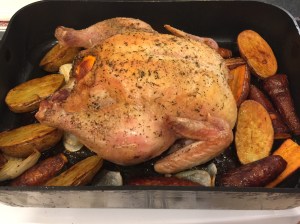
In the days leading up to Thanksgiving, we saved bits of baguettes from our meals to put toward the stuffing and had our plan for bread cubes. With the help of the produce man, we now had celery and sage, which left ground sausage for the stuffing. It is easy enough to find stuffed sausages of many varieties, but bulk sausage was not so easily found. We were able to find bulk sausage at the butcher next to the produce market. They quickly recognized why we were shopping and tried to sell us a turkey. It was tempting, until I remembered the size of the oven. They did, however, have a rotisserie filled with golden juicy chickens turning round and round. Even better, the slow roasted chickens were situated over roasted potatoes, potatoes which were probably already well laden with butter but now saturated with juices from those chickens. There is always mashed potatoes and gravy at this feast, but those flavor enriched potatoes erased all thoughts of that tradition. Our dinner shopping was complete, save a bit of shopping for wine–anything but a challenge in Paris–and fresh bread pulled from the oven hours before the feast.

On Thanksgiving, we sent a crew out to pick up chickens and potatoes while we made all the trimmings, rotating things in and out of the small oven beginning with our pumpkin tart-not-pie. We baked our stuffing in broth after cubing the saved bits of baguettes and tossing them with the sautéed onions, celery, sausage, and sage. Yes, we learned, baguettes do make wonderful bread cubes for stuffing. We cooked up some cranberry sauce with a bit of freshly squeezed orange juice and prepared haricot vert with mushrooms for our final side dish.

We had a lot of wine at the ready, and as every guest also brought wine, many bottles of regional French wines were opened, passed around, and enjoyed. Having a guest chef in the mix turned out to be an excellent idea, not only for the quality of wine he brought but also for his expertise in carving those chickens up faster than we could open a bottle of wine.

With the view of the Seine visible through the windows, we sat down to a memorable feast. Although missing a few of the traditional dishes and family back in the states, it was not lacking in the things that Thanksgiving is known for: beloved family, good friends, good food, good wine, and the thankfulness to be in this place, at this time, and sharing it with these people.

Photo credit for many of the photos to the spouse (everyone has a job in the kitchen, someone had to take pictures while the others planned, shopped, and cooked).

The Thrill is Gone

To call myself a foodie would overstate my knowledge and expertise in fine wines, top restaurants, exotic cuisines, and flavor profiles. But I do love to cook, eat good food, and enjoy a variety of wines. Although many of our books did not make our West Coast to Midwest move, the number of cookbooks that made the cut was exceeded only by the number of knitting books that made it on board the moving van. First captivatedby Julia Child so many years ago, moving on to Iron Chef (the original Japanese version), and now captivated by shows such as Top Chef and the British Baking Show, I find watching about food as enjoyable as eating it. There is little about travel I enjoy more than experiencing local cuisine. Of course it helps that it is one of the few travel experiences that lets me sit down and rest, but it is one of the best ways

of experiencing a new region. I may photograph more plates of food than local sites when traveling and relive my travels as much with memories of meals as with memories of excursions. Visiting wineries, participating in wine tastings, and experimenting with wine pairings has always been among our favorite activities. For all that–although admittedly falling short of foodie status–I certainly can be counted among those who enjoy good food and fine wines.

Imagine my horror when, in response to a malady, the doctor restricted my diet to all but the blandest of ingredients. Just say no to coffee, tea, acidic juices, and wine (or any other alcoholic beverage for that matter). Just say no to citrus or any other acidic fruits such as strawberries or pineapple. Just say no to tomatoes or any foods containing tomatoes including sauces, soups, and braises. Just say no to spicey foods. Just say no to fatty foods. Just say no, no, no.

There are pros and cons for the spouse. Although he can get the cheeseburger, pizza, burrito, spice-fest out of his system when he eats out at lunch, the dinners at home have held very little excitement. Rice or roasted potatoes, steamed vegetables, lean imagemeat, no dessert, wine in his glass, and water in mine. On the plus side, he can look at the wine cellar and say, “Mine, all mine!” He also has a sweet deal when it comes to a night out, a resident designated driver and lower restaurant tabs with only one person on the a bar bill.
If dinners for the spouse our dull, at least he is spared my very simple lean white meat
lunches and unflavored oatmeal breakfasts. Weekend breakfasts I avert my eyes so he does not feel my glare when he generously shakes Lousianna hot sauce on his eggs, peels off sections of tart juicy wedges from his tangerine, and enjoys slabs of butter on his toast. Eating has become something that is a necessity, not an enjoyment, like the routine of brushing teeth; necessary but not something to look forward to. That brings me to the kitchen. There is no inspiration to be found there. Meal planning is an absolute drudge. Grocery shopping has become a dull-eyed wander up and down the aisles with a nearly empty cart. Weeknight cooking has never been a high point, but to say the thrill is gone when I enter the kitchen every evening to prepare dinner is an understatement. Remembering Like Water for Chocolate, I can only think that my lack of inspiration and my malaise is as noticeable in the food itself as it is in my planning and preparing.

There has to be a silver lining, a plus side to all this. Well, clearly knocking out just about everything from my diet, including the empty caloried but oh so delicious wines, should be a boon for the waistline. But (wo)man does not live on bread alone, and watching a scale–although satisfying to watch numbers decline little by little–does not replace the loss of flavor and enjoyment of meals. So…perhaps I need to change my point of view. This could be my greatest kitchen challenge ever. Granted, I feel as limited as a chef-testant on Top Chef being told to create a masterpiece for a Vegan with celiac disease and a garlic allergy, but surely there is flavor to be found in the simplest of ingredients.image

Now is the time for those all those cookbooks to justify their added weight on the moving truck. And now it is time for me to crack them open, enthusiastic with the challenge and anxious for the inspiration. If I succeed, I’ll be back with a full belly and a mouthful of words. If I fail, my next kitchen posting may be when my health is restored and my whine is back in a glass where it belongs.

Name Calling

O, be some other name!
What’s in a name? That which we call a rose
By any other word would smell as sweet.
            Romeo and Juliette, Act 2 William Shakespeare

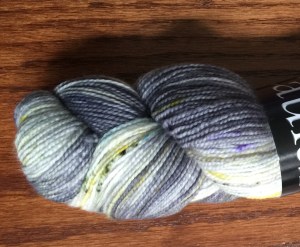
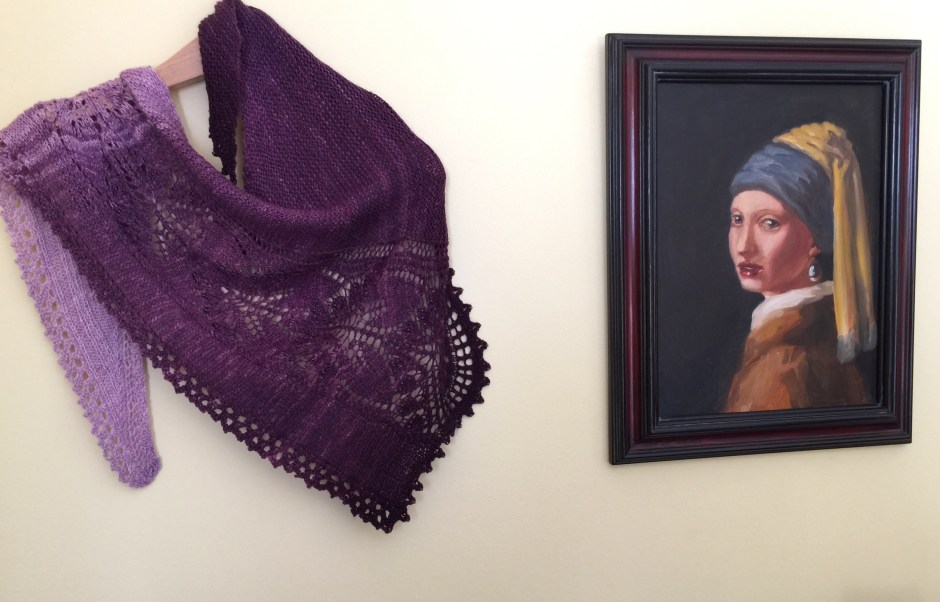
I grew up near San Francisco and have many fond memories of enjoying that beautiful City by the Bay. Among the many, many sights are the gorgeous Victorian houses, lined up side-by-side in an array of colors from soft pastels to the intense colors of the rainbow. They are often called “the painted ladies” by locals. Hearing that term brings vivid images and whistful memories of visits to The City to mind, so imagine my reaction when I saw a yarn in a gradient colorway from Fresh From the Cauldron called, “Painted Ladies” custom dyed for a a Bay Area fiber event.

I do not need any yarn. After years of reading evocative names, my resistance should be strong. Before letting a skein of Painted Ladies leap into my Etsy basket, I asked if there were any example projects knit with this yarn. There was. It was nice, a gradient yarn going from gray to yellow to white with speckles of color starting to appear imagemidway through. Gray to white, nice neutrals in the would-be-nice-to-have way. But with a name like that, it came to represent the lovely Victorian Painted Ladies peaking through the fog as it rolls across the many hills of San Francisco. It became my memories, my childhood, my youth. It became a must have. It became an item in my shopping cart, a package on the way, and finally it became another skein of yarn in my stash awaiting the perfect project.
As George Santayana famously said, those who do not remember the past are condemned to repeat it. So it has been with many a skein with an evocative name, attracting me to the idea but in the end bringing me varying amounts of satisfaction. Perhaps my first capitulation was a knit-along (KAL) using a skein of “Christmas at Downton” from Lorna’s Laces. It was every rich Christmas color one could think of, all joined together in one skein. The accompanying mystery pattern emerged week by week, bit by bit, finally revealing a pair of lacy gauntlets. As open minded as I am willing to be about the concept of gauntlets, if my hands are cold I do not want the openness of lace in my golves. They were frogged before gauntlet one was completed and turned into a shawl that went with every winter sweater, blouse, and jacket I had in my closet because it had every winter color I ever owned, and then some. It served me well for winter travel–but it was not a shawl I loved–and it soon found its way to a more winter color loving owner. It is a colorway that may still be available, and there are many lovely projects made with this yarn, but my love for Downton Abby just did not align with the colors attributed to the holidays at said Abby.

Abby holidays forgotten, I swooned and succumbed to “Winter is Coming,” another Lorna’s Laces colorway and another KAL timed with an upcoming season of Game of Thrones. This time the colors were a dream, so much so that I bought the KAL yarn weight plus a fingering weight in that colorway for good measure. The KAL pattern was nice but…not something I would wear. So as I pondered over what I should do with the KAL yarn–and the auxiliary yarn for that matter–I was contacted by someone who was part way through a sweater and in desperate need of a couple more skeins to complete it. So desperate, she offered to drive 3 hours each way to meet in a cafe close to where I live with cash in hand. Knowing the OMG-I-am-going-to-run-out panic and desperation, having met it once or twice before, I was ready to run to the Post Office and send it to her immediately, no questions asked. She could not wait that long. We met the following morning for the emergency exchange; like an ambulance bringing a donor organ, I transported the precious yarn to find her anxiously seated and awaiting her delivery. Having experienced first hand the value of this precious yarn, one would think that I would have immediately returned home and put the auxiliary skein to work. Not so, as of yet no project has presented itself that calls out for this yarn.

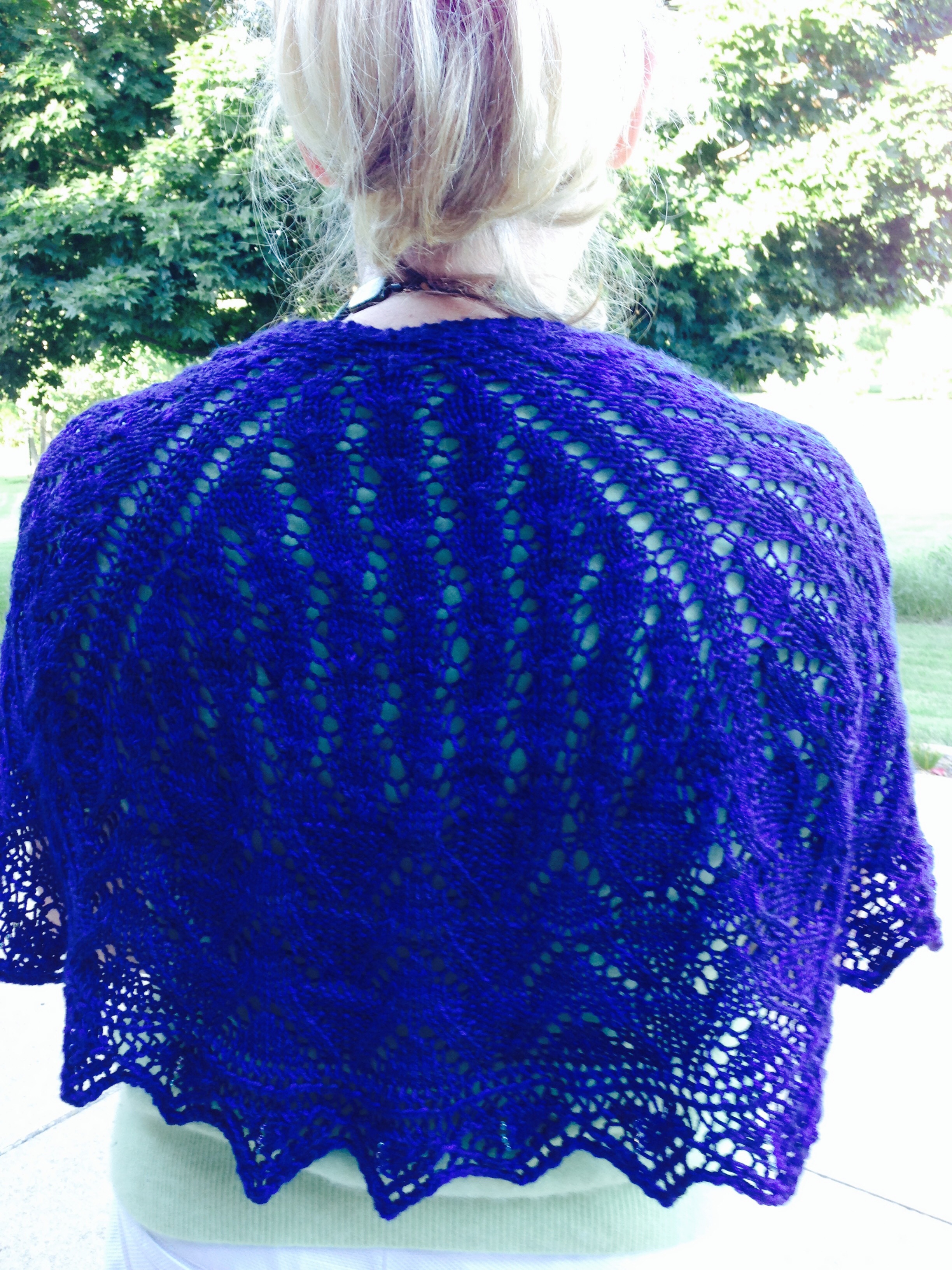
Sometimes the marriage of idea and yarn is a happy one. When I had to knit Lara Smoot’s “Mother of Dragons” because, well, who can resist donning a shawl and imagining herself as a mother of dragons, happily I found the perfect yarn by Dream in Color Smooshy in Cashmere (those words alone would make me want to wrap myself in the yarn) in a colorway called, “Naughty Royals”. The royals in Game of Thrones are pretty naughty, and with a few beads for imaginary dragon scales, I was on my way to the perfect set of dragon wings in a deep naughty royal blue with sparkles.

Oh there have been others that sang out to me, such as the yarn that recalled Princess Bride in the colorway “Prepare to Dye”. That turned into an infamous and rather clunky pair of socks. Another limited edition Downton Abby colorway Yorkshire Skies in lovely shades of aqua and blues that sent me back and forth, back and forth, and back and forth until my internal voice that said, “You do not need another skein of yarn in shades of blue” was drowned out by the, “But it is Downton Abby!” By the time I gave in the yarn had sold out, saving me from adding yet another skein yarn in shades of blue to my collection. A yarn with a great name, but still just another skein of yarn similar to ones I already have. I have heard my rational voice speaking, telling me to close my ears to the name and fall in love with the sight of the colors and the touch of the fiber; love the yarn itself not the idea of it. And sometimes I do heed that voice. It recently stopped me from buying a yarn that evoked Jane Austin as well as a yarn that referenced Princess Bride. It stopped me, after much internal deliberation, from buying a yarn dyed exclusively for a retreat I attended. It has reminded me that names referencing beloved authors, books, series, or movies should not prejudice me to love a yarn that I otherwise would at best like somewhat or at worst not consider at all.

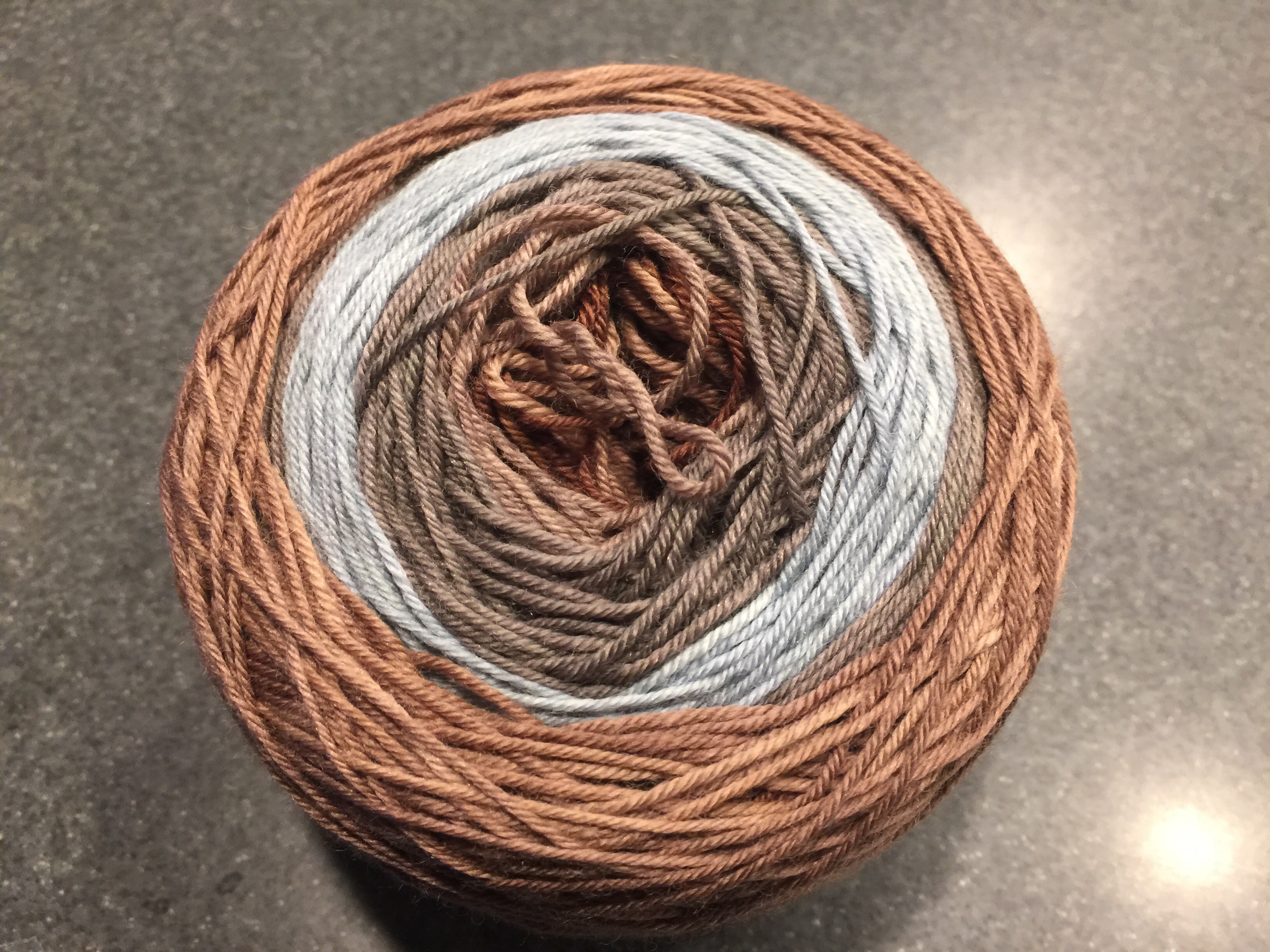
It did not stop me when I read a name that captured me the moment I read it, “Jamie’s Kilt.” A set of mini-skeins in the muted colors of an old Scottish kilt are nice enough, but put that name to it and that yarn was in my cart and checked out minutes after reading the yarn’s name. It did not stop me from telling my knitting group about it, all of whom loaded their carts and checked out within the next 24 hours. Each of us are embarking on our own personal journey in our group’s KAL; each choosing her own personal way of being wrapped in Jamie’s kilt. That name silenced all our rational voices, thoughts, and restraints.

For all the hours that are spent knitting, perhaps the joy felt from inserting myself into a story, or a place, or a time, or a memory, stitch by stitch, is reason enough for allowing rational thought to give way to imagination. If the very idea of the yarn increases the pleasure of seeing and touching the yarn through its long journey from selected skein, to wound cake, to yards of fabric, then that long journey is just that much more enjoyable for the knitter behind the sticks. With over 600 yards of Jamie’s Kilt to knit, there is a lot of enjoyment in my near future. And in the end, having made that journey, I will be wrapped warmly in Jamie’s Kilt long after the Visa bill is paid and forgotten.


My Care and Feeding of Fine Fibers

No one in their right mind would seek to save money on clothing by knitting. And no one who is not a knitter would understand paying for the material costs for a hand knit sweater when online shops, brick and mortar store sales, and various discounters offer inexpensive machine made sweaters made from sturdy blended fibers. But for knitters who buy fine fibers and non-knitters who are lucky enough to receive a hand knit gift or feel flush enough to splurge on luxury knit garments, it is good to know the care and feeding of fine fibers for years of enjoyment.

I titled this “My Care and Feeding…” because there are many approaches and even more opinions on how to give fine fibers the loving care they deserve. This is what I have found works for me. The first section about blocking is for knitters who have just finished knitting an item and need to do the final shaping.  The sections on caring for finished knits are for anyone who has fine or hand knitted items and loves them enough to care for them.

The Final Finishing for Knitters: Blocking

[Non-knitters will want to skip to the next sections for care instructions]

When an item comes off the knitting needles, it is not ready to wear. Loose ends are woven in and snipped and the item is given a nice long soak in a quality no-rinse wash such as Kookabura Wash (my favorite) or Eucalan Fine Fabric Wash, both available on Amazon and in local knitting shops. Natural fibers such as wool really absorb water, and that combined with the natural elasticity of the fiber can be both a blessing and a curse. The blessing is that stitches can be smoothed out, the garment can be shaped, and lace stitches can be opened up and pulled into place to display the lace, cables and ribs can be straightened, and longer can become wider and vice versa. This is referred to as blocking. A bit like going into the editing room after filming: if the acting is bad and the shots are out of focus no amount of editing can fix it, but if the shooting is basically sound the editing fine tunes it and brings it all together. So it is with knitting. Blocking brings out the best.

And the curse?  A piece of knitting saturated with heavy water is going to stretch stitches and shape all out of recognition. Without care, a sweater becomes a mini-dress. What I do is drain the water from the sink, immediately wrap the piece–all wadded up–into a bath towel and put the bundle into my top loader washing machine on the spin cycle only. I doubt this would work with a front-loader machine. Another option is to put the bundle into the bathtub and step on it to squeeze all the water out. Some people use a speciality device that is just a spinner. The point is to get out as much water so that the item is wet and pliable but not saturated and sagging.

image
All those hours for this?
I use one or two blocking boards. Others have used interlocking foam pieces; there are interlocking blocks made specially for this purpose and a child’s foam floor puzzle also works for some. Another option is to put a sheet or blanket on the bed and lay the piece out on top. Some items require just a gentle shaping and straightening, others need a bit more encouragement to get into shape. My blocking

image
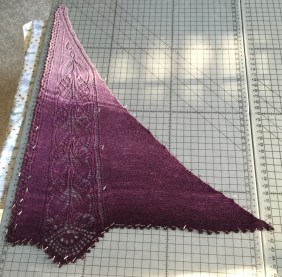
Tugged and pinned into shape
boards have lines so I can align sides and keep things even. When something is stretched, it is important to note that fibers such as wool tend to shrink a bit when they dry and need help to hold things in place. When lightly blocking  I often pin parts in place to keep them shaped. Blocking wires can be useful, particularly for pulling out points of lace or keeping an edge perfectly straight. Pins and/or wires are essential to hold things in place for things that need to be stretched.


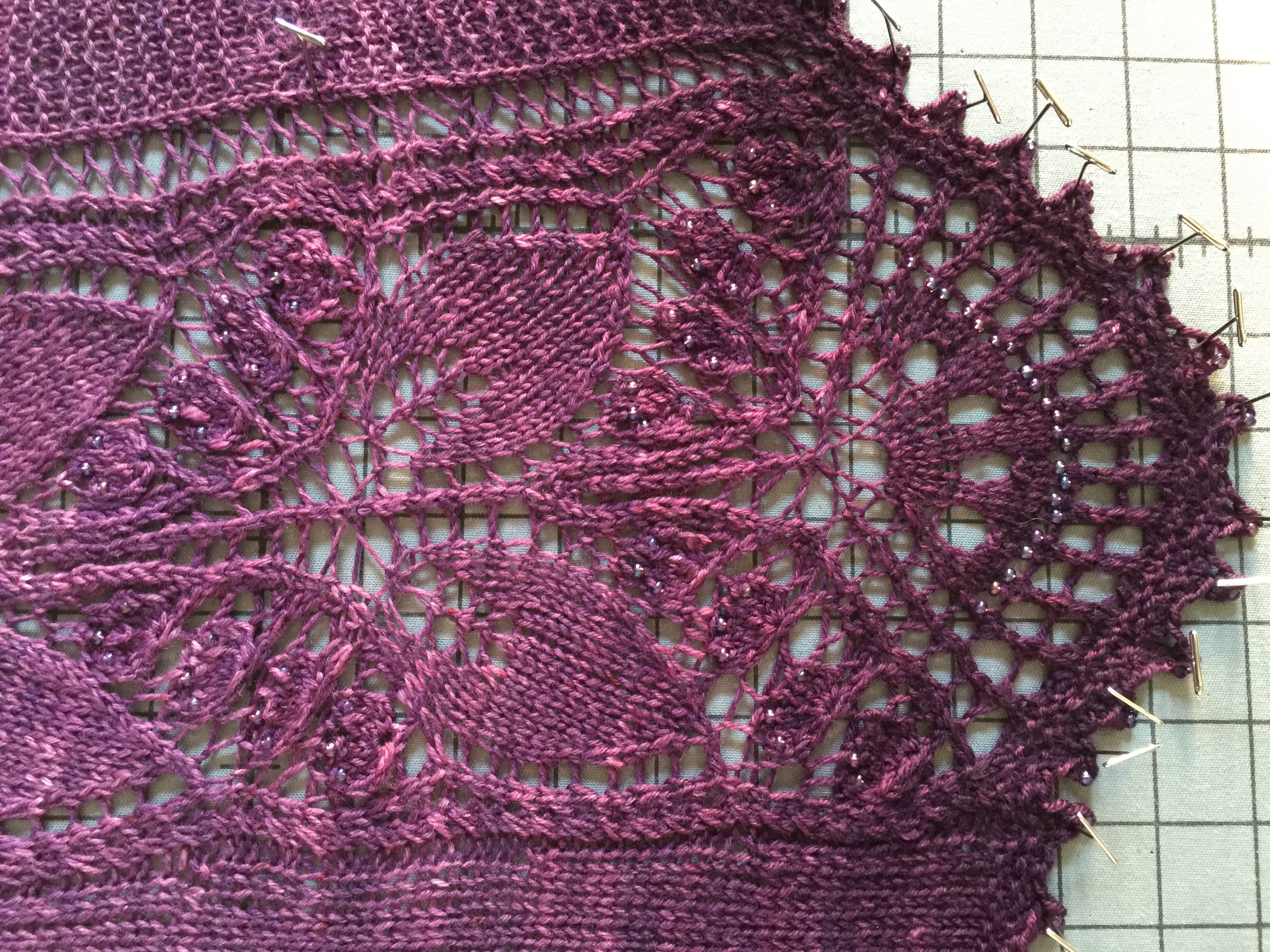
For lace shawls, I start from the top and gently shape the body of the shawl before working and pinning the bottom edge. If the pattern has a schematic, pay attention to the shape of the top. Sometimes the top is a straight edge but sometimes, as with many crescent shaped shawls, the top edges curl up like a villain’s mustache. When the bottom has a lace edge, I pull out the points if applicable and open up and even out the lace while pinning it in place. I tend to use a lot of blocking pins and would rather pin it into a frightened porcupine than fiddle with interweaving a lot of wires, but it is all personal preference and what is important is that it is put into and held in place while it dries.

I once took a drawing class where we spent three 3-hour class sessions with a pieces of charcoal and pages and pages of newsprint on an easel drawing straight lines over and over again. The lesson was to show us how we lie to ourselves that a line we have drawn is straight. That class may be the reason I knit and do not draw. They may have gone on drawing lines in subsequent classes, but after nine hours I dropped the class having learned the lesson. A long time bending over a blocking board with a lacy piece can lend itself to that same self deception. One only has so much patience. My final step is to photograph it on the blocking board because for some reason I can see distorted lines in a picture but fail to see them while nudging and pinning the piece into place.

image
Lots of points, lots of pins
Another option is to steam block a dry item, which requires an iron or steamer that emits a lot of steam to moisten the work. I have not done this; after working with and dragging a piece of knitting around for weeks or months, it is more than ready for a good bathing and for that reason I always wet block.

I may be totally delusional, but I weave in and clip ends before washing and blocking with the belief that the knitting fairies will felt those bits into place in the process. Others swear that this should not be done until after blocking and still others say to weave in the ends before washing but clip the ends after blocking.

YouTube and Google searches will turn up lots of information about finishing and blocking knits. Many of the classes on Craftsy cover finishing and blocking.

Caring for Finished Knits: Washing

Dry cleaning chemicals are harsh on fine fibers. Even if a label says, “Dry Clean Only” I never dry clean fine fibers. For purchased finely knit cashmere or merino sweaters, I have a knit cycle on my washing machine that is very gentle and have had good luck with Wool and Cashmere Shampoo by the Laundress, a much gentler product than Woolite or the like. If I did not have a good machine for this I would definitely hand wash these sweaters.

imageFor more loosely knit purchased or hand knit items, I hand wash in cold water using a no-rinse product such as Kookabura wash or Eucalan, letting it soak for about 15 minutes then running some water over the item without handling it. As described in the blocking section above, fibers become saturated and heavy and the item should be handled as little as possible before getting as much water out of the now vulnerable piece as one can. Handling very little and very gently, I wrap the piece in a bath towel and put the bundle in my top loader washing machine on spin cycle. If I did not have a top loading machine, I would press out as much water as possible from the towel, even standing on it in the bathtub if necessary.

When the item is wet but not heavy with saturation, it is safer to handle the piece. Many natural fibers such as wool are very elastic. I find many of these fibers have memory and they often want to go back into place. Still, the piece needs to be given a reminder and the best way to dry it is to lay it flat and gently shape it into place. This can be done on dry towels on a bed, a dining room table on towels atop a waterproof tablecloth, or towels on a floor if not in the path of people or animals.

The list of thou shalt nots: Do not dry clean fine fiber. Do not use a harsh soap; use a gentle no-rinse product specifically made for fine fibers. Do not wash fine fiber in hot water. Do not machine wash in a regular wash cycle with warm or hot water; a washing machine may be okay if you use a delicate cycle that is really delicate and you use cold water. Do not put fine fibers in the dryer; lay flat to dry is best. If you “do” a “do not” your adult sweater may either become very thick and toddler sized or thinned, saggy, and stretched out beyond all recognition.

Products mentioned for washing can be found on Amazon or at local knitting stores or, for other options, you can always ask your favorite search engine.

Caring for Finished Knits: Storing

Heavy sweaters on a hanger may succumb to gravity over time.  These are probably best stored folded on a shelf or in a drawer. I currently have my shawls draped on a mannequin, I like to imagine that moths favor dark private places rather than being out in the open but I could be mistaken. I have read that moths are more likely to be attracted to fibers that are not clean, so I make it a habit to wash all our knits at the end of the cold season. Our heavy winter sweaters I store in plastic bins with cedar blocks. Our season spanning knits I store in drawers with cedar liners and/or lavender sachets.

Caring for Finished Knits: Repairing

Sock heels can be darned or, with some patterns, heels replaced, but I am not going to cover sock wear repair here. What I am going to cover is common problems with other garments from wear. There are tailors and re-weavers who can sometimes repair items, but many repairs can be made without requiring special skills.

When a garment is hand knit, there are yarn ends that have to be woven in and snipped. Sometimes these ends come loose. If it is an end, not a snag, the best thing is to pull it through to the inside or the side that is not normally seen. A crochet hook works best for this, but I have also been able to work a strand back through to the other side with my fingers. When it is on the side that does not show when it is worn, it is safe to snip the end while being careful to not cut any stitches.

A snag is when a stitch is pulled and it is like a loop coming up from the knitting. Never, ever cut this. Taking a crochet hook, gently pull the loop back through to the side that is not shown. Sometimes it is possible to gently urge the stitches back into place, but that does take a knowledge of how the stitches are joined together in the fabric. If it is a small snag, bringing it to the side that does not show may be enough. If it is a large snag, try to weave it in under other stitches to hold it in place.

Pilling is when all those little balls show up in places like the underarm of a sweater or the wrists of a sleeve. Sometimes they can be just pulled off by hand. There are shavers and combs made specifically for the purpose of removing pills, and they work fairly well. Really soft fibers with a halo are more prone to this, especially on something like a sweater that is subject to the rubbing and abrasion of being worn on moving parts. I have often improved things on a sweater, but I have never resolved the problem of pilling completely. It is just the trade-off for exchanging tightly twisted firm fibers better suited for sweaters with softer, cozier but less rugged luxury fibers.

Caring for Finished Knits: Reshaping

Sometimes mistakes are made in washing or storing a garment, changing its shape or size. If it is stretched or the stitches seem loose after washing sometimes you can tighten the stitches by breaking a rule: put it in the dryer briefly. This requires patience, dry it 5 to 10 minutes at a time or it could go too far the other way and you will be looking for a mini-me small enough to wear it. If the item is dry, I sometimes put it in the dryer with a damp towel for a few minutes.

If the garment has become misshapen or the stitches have tightened, sometimes it can be blocked back into shape. If you are a knitter, give your garment a good soak and read the section on blocking above. If you are not a knitter, find one and offer a bottle of wine or a box of chocolates in exchange for their blocking tools and expertise.

Loving and Cherishing Knits

With proper care, storage, and cleaning, hand knits can last for years. For those of us who knit, it is wonderful to see our recipients care for and enjoy our work. For those of us who have been recipients of hand knits, what could be better than years of being wrapped in something lovingly made by the giver, be it a parent, a friend, a beloved aunt or uncle, a loving partner, or even a stranger knitting to give comfort to someone unknown.


Vote for (none)

We live in a small town a bit outside the fray. Still, close enough to the fray to have some of the voter diversity that a college community typically offers. Yet with the lines that are drawn by the powers that be, our district is distinctly a bright brilliant shade of red without so much as a tinge of purplish cast. For local and regional elections, my vote is a whistle in the wind in a district scarlet with moderate to love-my-God-love-my-guns (not necessarily in that order) Republicans.

We first realized we might be in an exclusively red area when a candidate at the farmers’ market in town asked for our support. Upon learning that we were not in his district, he said something along the lines of, “You will get no attention from Democrats out there. If you need anything, just contact our office in town.” In our first election cycle here we discovered what he meant. There may be registered Democrats in our town but there are no Democrats in the running for the local or regional offices in our district. Our representation is strictly Republican, and unfortunately so as far as I can tell, of the God-and-guns and not the moderate variety.

In California, with countless propositions and candidates of all stripes, we were provided with a giant sample ballot and a voter booklet that described both the pros and cons of each proposition and statements from the candidates, not to mention the a barrage of mailings, television ads, phone calls, and ringing doorbells. It is a bit quieter around here, a couple of mailings from the better backed (i.e, funded) candidates and that is about it. I did not even know what was on my ballot and had to look it up online to see what decisions were mine to make. In California we had a system whereby if you opted to vote by mail, and–if you did not miss an election cycle–you were automatically mailed a vote-by-mail ballot. No such system here, but having once voted by mail I get an email inviting me to apply for a vote-by-mail ballot. This is a great thing, because often it is the only way I find out there is going to be an election. But we do have early voting.

Early voting is the opportunity to go to the polls anytime from early morning to early evening in the week before the official Election Day. A couple of nights ago I did an online search for my primary ballot, looked at my few choices, and made my decisions in preparation for voting. Yesterday I donned a livin’ on the prairie flannel shirt, the appropriate blend-right-in attire for entering a den of redder than red voters. Sure enough, the two people in front of me were Republican: one a dour and silent man who quietly collected his ballot and bee lined to his voter kiosk with eyes front and expression firmly set, and the other a recently coiffed, immaculately dressed, mostly grey-haired lady with the friendliness and easy chatter so common to many Midwesterners. When asked if she was Republican or Democrat she said, “Republican, but really Independent.” That launched us all into a yes, who-likes-either-party-we-are-all-independent exchange of remarks as the election official printed out her two page ballot. I exhaled, knowing this well dressed and carefully coiffed lady was not likely to be a pushing, shoving, belligerent Donald supporter. Or, if a Donald supporter, certainly not of that ilk. As she walked away to fill out her multi-page ballot, I stepped up, signed in, and with less fear of scowls and Donald-worthy sneers, declared “Democrat” in response to the which party question. One partially covered single-sided page printed out.

I took my little ballot to the private kiosk, with instructions to insert my ballot into the privacy cover before bringing it to the voting machine. There I selected from my limited primary options for national and state level positions. Office after office listed “no candidate filed,” leaving me little to do. My Republican friend swiftly filled out her ballot, carried it to the machine snug in the privacy cover, fed it in the machine, and turned to leave as I followed behind with my covered ballot. My ballot would not go in. The official stood by as I tried to feed it to the machine a few times then stepped in and flipped it this way and that, naked of its cover, and attempted to get the machine to swallow it whole. Finally, removing the feeder cover, we discovered an accordion shaped two-page ballot obstructing my one-pager. Our friend was just stepping through the door but heard the commotion and returned. Heedless of my naked ballot with its few marks, I quickly averted my eyes from the naked accordianed mult-page ballot lest I break all codes of voter secrecy or, worse, be disillusioned by the discovery of which Republican Presidential candidate she had marked. Mine, all this time, was hanging out in all its naked glory. Cleared of the obstruction, we jointly fed my scantily clad and scantily marked page into the machine successfully, my secrets revealed to all who gathered there. After an exchange of a few pleasantries, my eyes still averted from the other ballot, I left everyone to their task of solving the accordian ballot puzzle.

Safe at last, no dirty looks or sneers in my wake for all that exposure. As the door was closing behind me, I heard, “Oh no, she forgot her voting sticker!” The official raced to and reached the door just as I was reopening it to return for my well-earned sticker. “You cannot leave without your sticker,” she said. So there it was, I was still A-OK in spite of my vie en rose; they wanted me to have and proudly wear my “I voted” sticker. Maybe we can all get along.

I do not know if the votes I have cast have ever made a difference. I proudly registered to vote the moment I turned the legal age of 18, my first real step into adulthood and citizenship. Since that time, I have made it my mission to vote in every election. It is true that so many have put their efforts and even their lives and safety in peril for the simple right to vote, and that alone should inspire me. But the real reason I vote? I believe exercising the right to vote gives me the right to share my opinions and voice my complaints. Because–in spite of the many vote for none options–I vote in the hopes that we will one day elect people who, regardless of party affiliation, can get along and work together to solve problems as cordially as we the voters, from different parties and different backgrounds, were able to do in our little polling place. That, and that one day they will draw some reasonable district lines.

image

Footnote (TITW Concluded)

Overcoming second sock syndrome, broken needles, dropped stitches, and shreddy yarn, I now have a pair of baggy, floppy, but very comfortable socks. I also can claim to have had the DPN (double pointed needle) experience to add to my attempts of twisting magic loops and juggling two circulars. In the end, I am still not entirely sold on either knitting socks or using DPNs but am still willing to get caught by the craze. As I told one friend, I may not have been bitten by the sock bug yet but I think I have been nibbled.

I did make a few discoveries in this process.

imagePerhaps my best discovery along the way: I can knit a little project and peddle at the same time. Why my knitting bag looks like it was designed to fit my excercise bike. At last I have mastered aerobic knitting and proven once and for all that knitting is good for you.
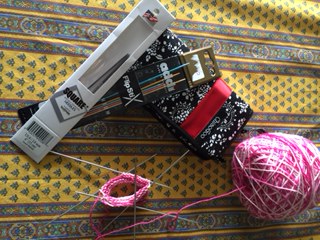
I have also discovered that I am a beast when it comes to needles. It was during this process that I learned my wooden Darn Pretty needles are in huge demand as they are no longer being made. After having snapped so many toothpick sized needles, there was no way I was going to put those pretty little wood sticks at risk. People selling these are taking offers, not setting prices. So that is what I did. When offers started to come in I knew they had to be sold or they would be the grandma’s china of needles; put away in a cabinet to gather dust because they are too far too dear to use.

It is not a discovery that when one sock is finished there is a whole other one to do. And it was not so much a discovery as an admission that, however certain I am that I will remember exactly what I did at each juncture, I never do. A thought for doing socks in the future: do a pair in tandem. Other than having to buy still more needles, what could be the downside? Sure I did not like the fiddly two at a time thing with two socks dangling off of two circulars, but I can definitely see the advantage to doing them in tandem: the legs on one then the legs on the other, the heels on one then the heels on the other, and so on. When I finish one I will be very nearly finished the other, and at every step it is fresh enough to remember what I just did. I might even get a matching pair.

I also discovered that being committed to a single method is just stubbornness and perhaps even silly. On my second sock I became less of a purist. When it came time to cast on stitches or hold stitches aside while I did the heel flap, it made a lot of sense to use a longer circular needle. Any time there is a large number of stitches, why risk having them fall off the edges just because one is comitted to using DPNs? Choose the right tool for the job I say, even if it means mixing it up a bit.

imageMy final discovery is that wood is nice but a brute belongs with metal. Not ready to throw in the towel–or the sock–I am doing the next pair with metal DPNs. I swatched with Chiagoo metal DPNs, Addi FlipStix, and Kollage Square DPNs. Although a very popular needle, I find the Karbonz tips catch the yarn so did not include them in the test. Metal is in my comfort zone. Every pair felt more secure and easier to handle than any of the wood needles I had tried, the stitches that came of the needle were meant to. My gauge was identical for the Chiagoo and Addi needles and only slightly larger for the square needles. I had no clear favorite. Well, maybe the Addi FlipStix because the colors are so fun. My decision is to go with the square needles as they felt really secure and easy to handle, plus I want to see if the claim of less hand fatigue is true.

So, I am going to try, try, try again with the DPNs (in metal) and hoping for improvement each and every time I knit a pair socks. The first few will not be gifts, no need to test someone’s honesty versus politeness in writing thank you notes. But gifts are a part of knitting so it will be improve or move on to something else. Perhaps a Christmas stocking or two. Same concept but no sizing issues, and absolutely no promises about sticking to DPNs.

image


Got it Covered

“Face it girls. I’m older and I have more insurance.”
― Fannie Flagg, Fried Green Tomatoes at the Whistle Stop Cafe

Insurance is one of those monthly out the door expenditures that translate into a lot of cash in any given year–cash that could be spent on things one actually sees,  holds, or enjoys–but it does buy a sense of security.  No matter what the eventuality, those policies standby like a big brother there to protect you.  Or do they?

With regular medical and dental care, it is difficult to avoid accessing any insurance but in general insurance policies are usually paid and ignored.  In many cases there is the fear that costs could increase even more if a claim is made. By making no claim on it, the comfort of thinking insurance is there to protect you remains undisturbed by the knowledge that it may not.

We were amazed one day to see hail the size of golf balls and tennis balls bouncing off our patio, it was such an amazing sight and not for one moment did we stop to think that those bouncing balls of ice were also hitting our house.  It was not until I saw fleets of roofing trucks around the neighborhood that it occurred to us to have the roof checked for damage.  Two contractors said we indeed had hail damage and should call our insurance company.  I thought it was on us, that we would replace a few shingles, do some repairs, hand over more money than expected, and soldier on.  Thinking it would come to nothing, I called our insurance and the first person I spoke to put the fear of God into me about, “Having a claim on your record” if the damage was not attributed to the hail.  I hung up and called one of the contractors, who assured me that it was indeed hail damage, and he offered to meet the insurance adjuster to show him that damage. He was certain and assured me it was worth my time and effort.

The adjuster came and inspected the roof with our contractor. Everyone agreed there was damage from the great balls of ice and our story ended happily with a brand new roof for the cost of our deductible.  We suggested a lower cost composite roofing material, knowing that many of our neighbors had gone with composite rather than cedar shingles because of the cost, but it was our replacement insurance that filled the gap between the amount offered for the depreciated age of the roof by our regular insurance and the cost of a replacement; we had to use the same materials as the original. In the end we got a brand new cedar shake roof, window screens, and gutters.  We were unexpectedly covered for a very large expense.  The need for a new roof was inevitable given the age of our house. Were it not for Mother Nature we would have been facing the cost of a roof in the not too distant future. Insurance came through in a very big and very unexpected way.

But that is not the only story.

It was one of those normal winter days tucked between polar vortex events, sun shining and temperatures hovering around a balmy freezing as compared with the usual subzero temperatures of that winter.  I had ventured out to do some shopping and was edging my way up a lane in the parking.  Suddenly I saw an SUV pull out fast from behind a van. Being in a parking lot, I was moving slowly and was able to stop about two slots before the SUV, leaning on my horn for good measure. The SUV was coming so quickly that it was not enough to give space and noise. Clearly the driver had other things on her mind as she was both deaf to the horn and heavy with her foot. My poor car– less than a year old at the time and still sporting a trace of that expensive new car perfume–jolted and cried out with that indescribable sound of crushing, crinkling, cracking metal and plastic.

Issuing a silent reminder to myself to stay calm, I collected my purse and grabbed the door leaver to get out of the car. The door would not open.  I tried again, it made a little groan but would not budge. My car has a console between the front seats, which is very handy for storing my purse and convenient for shifting gears, but for climbing over it is a daunting barrier.  But given that both seats have head rests reaching nearly to the ceiling my escape routes were limited, climb over it I did, pushing the driver’s seat back as far as I could and, fueled by adrenaline, somehow managed to struggle to the other side.  It was not a pretty sight.

Once freed from my twisted metal I had a brief moment to examine hers, rust showing through places in the tired black paint, former damage that included what could be bullet holes to my heightened imagination, and a brand new ding on the aged bumper. And I was about to meet the occupant.

There is a very unusual Southern/Central Illinois accent that some people have here, very difficult to explain but consider that, although surrounded by the midwestern states of Indiana, Iowa, and Wisconsin, Illinois shares a border with Kentucky to the south and Missouri to the west.  There is a blending of accents that I am still learning to recognize, but I would say that I noted that accent as she said, “I don’t have insurance,” followed by, “This is my boyfriend’s car and he doesn’t have a driver’s license.”  Things continued to get interesting when she said, “We are moving this weekend and I am not sure what my address is.”  Her little girl got out of the car, her presence reminding me about the staying calm thing. I said, “Let me get my information,” and returned to the car looking for all the world calm and self-possessed until I tried and failed to open the door. Silently regathering my dignity and swallowing an expletive or two, I went to the passenger side, got in the car, closed the door, called 911, saying, “I have just been hit by an uninsured motorist.”

I had reason to remain calm, an inconvenience of course, but I do have uninsured motorist coverage.  And now, covering all bases, I would have a police report. I returned with my insurance cards and drivers license, informing her that the police were on their way. While we were waiting I took pictures with my phone of the damages. All would be well.

A car came up the lane and I realized I would have to move my car to get it out of the way of other cars (and it would box her in so she could not drive off, so definitely worth the effort).  I opened the passenger door and commenced the ugly and awkward climb back into the driver’s seat, moved the car, then struggled back out again to await the police officer.  Later I discovered that the easiest way in and out was to go backside first dragging the legs behind, not feet first followed by an attempt to bend in ways unnatural for someone far younger and more limber than I.  I did not know this at the time.

A nice young community officer came and took our individual statements, entered our information, and called it in.  The driver, perhaps nervously, chattered away as the waiting time dragged on and on.  Perhaps what she was telling me was an effort to gain sympathy for her circumstances, and for the most part it worked.

Although not a polar vortex day, the thin sunshine did little to keep the creeping chill from setting in. Still silently reminding myself to stay calm, I noticed the back seat of the police car looked sparse and hard-edged, not a space I would want to experience. I observed aloud, “It does not look very comfortable back there.”  Not missing a beat, she responded with, “Oh no it isn’t. I hate riding back there.”

Nearly an hour after he arrived, the officer finally began to print our copies of the report but had just enough thermal paper to print one.  He struggled with loading the printer for some time before giving up.  Saying that he still had to write the other driver a citation for driving without insurance, he let me go with the one copy.  Once again I climbed into the passenger seat and, not having discovered the easiest way to get across the great divide, struggled and strained to get to the other side, eventually getting all my parts in one place. Unbent and ready to drive I was set; with my uninsured motorist insurance, photographic evidence, and police report all would be well.

When I parked in the garage, somehow I made the great discovery that back-end first was easier than grunting and groaning and bending in ways I do not bend. Things were looking better already. It was with great confidence I called to report the not-my-fault-according-to-the-official-police-report accident to the insurance company.  It was then I learned that, yes I do have uninsured motorist coverage but…I was not insured for an uninsured motorist damaging my vehicle.  Uninsured motorist insurance is for medical expenses only, not for property.  Although a little worse for wear for all the bending and struggling between the driver’s and passenger’s seats, it was not medical coverage I needed. My car’s front end was crunched and, although my slide back-end first discovery was a great improvement, the driver’s side door really needed to be fixed.

Unlike the great balls of ice, the uninsured motorist story ended less happily.  My collision insurance paid to fix the car, but I was told by the insurance adjuster to collect the deductible–our higher deductible to save on premiums deductible–from the uninsured driver.  The saying, “blood from a turnip” came to mind, as did the thought that she had my name, my address, my phone number, my driver’s license number, and my car license plate number.  Not only did I not want to make an obnoxious nuisance of myself but there was no phone and no address, just a driver’s license number and a plate number for a car that belonged to someone else. Blood from a turnip that could not be found.  I was resigned to the fact that I had just learned an expensive lesson about uninsured motorist coverage.

Some months later, I got a letter that the claim was still open.  I called and was informed that they were in the process of trying to get the cost of my repairs, including my deductible, from the uninsured driver.  From what I gathered, they had not been able to find her.  Still later, I got another letter from a collection agency saying they were attempting to collect for the insurance company.  As far as I know, the claim is still open.

My reality is, the case was closed that first day when I was told what it meant and what it did not mean to have uninsured motorist insurance. I paid the deductible and considered it essentially a poverty tax. There will be times when those of us who are fortunate enough to be able to afford insurance, deductibles for repairs, newer cars, and permanent addresses will encounter those who are less fortunate and cannot afford all of those things combined. It is random, it is upsetting, and perhaps it is even unfair, but in the end perhaps it is the the risk we assume for having while living among those who have not. It was a random misfortune to be hit by someone who could barely afford to operate a car and could not afford the “luxuries” of insurance. Yes, it is against the law to drive without insurance in our state, but if it is a choice to be grounded or to break the law to drive and survive, then I must believe that there are many more on the road just like her.  A randomly assessed poverty tax and I only hope I have paid my share.

So, a split decision on insurance, one experience came through with more there than expected and one with less. We need a tie-breaker.  More in the next blab.


Goin’ Down to the Crossroads

In some ways, day-to-day life is pretty much the same no matter where that place called home is situated.  But I can say with certainty that my first Midwestern volunteering experience would never have happened while living in Silicon Valley.  

After moving, I took it slowly when it came to getting involved with the various groups in the area. My first experience volunteering was for a local music festival. I naively thought, sure I could be the handler for a visiting artist.  What could be so hard about that?  Even I could be hospitable for just one night.

I went to a rather chaotic volunteer meeting–one of those where just about everyone other than me had done this before and knew what they were about–learning next to nothing about what I was supposed to do and when I was supposed to do it.  Fortunately, someone called me days later with a few more details.  I was to pick up and escort an artist tagged with a rather unfortunate name, one of those inappropriate names that makes a person cringe to speak aloud, a name like “Washington Redskins.” In spite of the abhorrence of many Republican candidates for political correctness, every fiber of my being recoiled against calling an African American male with a visual impairment by this name. But that is what he calls himself, and that is who I would be shepherding.  I vowed to learn his given name as quickly as possible. 

Unfortunately, yet-to-be renamed artist was having difficulties with an international flight coming through New York and would I mind picking him up at midnight at the bus station on Friday night?  Meeting a blues musician at midnight. I turned to the spouse after hanging up the phone and said, “I’m goin’ down to the crossroads.”  I tried to get across that perhaps I was not the best person to be hanging around bus stations by myself at midnight; were something to happen the local paper would report me as “Elderly woman struck down in bus station.” Fortunately the delay was even longer, so rather than at midnight it was at noon the following day that I lurked around the bus station waiting for the artist.

I did not need help to pick him out of the crowd, he was the only one climbing off the bus carrying a banjo, a guitar, a cane, and dressed in overalls and floppy hat like a depression era dust bowl escapee.  The first order of business was to take him to his hotel to check in and clean up. I brought things to do expecting to have to wait for him in the lobby while he freshened up.  But no, he wanted to just drop his stuff, grab a bite, and get jammin’ with all the other musicians. He then surprised me with the question, “Where can I get Kosher food?”  I had no idea but remembered a friend telling me that their Jewish family tradition on Christmas Day is to eat Chinese Food. I suggested a Chinese restaurant and this was acceptable. In thinking he would want to sit down and eat I was mistaken once again.  No time for food, he wanted to get jammin’ with all the other musicians. Off we went with a couple of styrofoam containers filled with Chinese food tossed into a bag.  He had flown across the Atlantic through New York, connected on a domestic flight, and boarded a bus to his final destination.  An exhausting trip, yet he was still moving with purpose, not even a pause to change his shirt or stop to eat.

The festival had workshops, jamming sessions, and performances at several venues around the town.  I guided him to the green room in the main venue so he could eat his food and relax with other musicians.  Nope.  He dropped his bag of styrofoam containers on a table and took off for the stage and was soon jammin’ with whoever would pick up an instrument.  In a very short time I had to round him up to get him to another venue, untouched styrofoam containers left behind, for his next workshop.  

We arrived at an intersection and just as I was about to guide him across the crosswalk he took off diagonally across the middle of the street–full speed ahead–with me chasing after him, all the while trying to signal the traffic to stop, hoping the drivers could see his white cane.  Getting him from one place to the next was pretty much the same, always having too good a time to leave but in a big hurry to get to the next stop once I got him moving.  His first performance venue was at a bar.  The bar was packed when we entered, me carrying banjo and guitar cases and he holding his cane. Before I could finish checking in with the gatekeeper, he pushed through the crowd towards the stage, leaving me to weave my way through aften him while trying to avoid whacking people with the heavy cases.  I caught up with him at the side of the stage, set his cases down, and just when I was hoping we could stay put a moment he says, “I need a whiskey to clear my throat.” I probably did too, but off I went to the bar to buy him a shot, hoping he would stay where I left him and wondering if whiskey was Kosher. 

Apparently one whiskey was enough to wet his whistle, but clearly not enough to get him through the performance.  Soon he had audience members handing him up shots of whiskey.  With great optimism, I thought it might slow him down a bit.  Wrong. We got back to the main venue and, after a brief pause to eat out of those styrofoam containers that had been sitting there for hours, he was just getting started.  

His performances had concluded and I believed my job was done, then he found the dance floor. At this point I had been his keeper for over 10 hours and while I was completely and utterly exhausted he had only just begun.  I must have looked spent because at this point one of the organizers took pity on me and offered to find someone to take him back to his hotel when he was ready.  Later I heard he went back to his hotel sometime in the wee hours.  Forget going down to the crossroads at midnight, he was jammin’ well past the midnight hour and into the dawn’s early light.

Not sure if it was the Kosher food, the music, or the whiskey shots, but he certainly had seemingly endless jet-lag impervious energy and joy that sprang from somewhere. Even spotting me a trans-Atlantic flight and cross continental journey before my job started, I could not begin to keep up.  I think it is too late in life for me to dress in overalls and play the banjo–and I don’t have a taste for whiskey–but I could try Kosher food for stamina.  Who knows, maybe there really is something to that chicken soup.

Went down to the crossroads and what did I find there? Nothing but energy, energy fueled by food, whiskey, and music, energy fueled by pure joy of life.