

What happens when a group of knitters start with identical skeins of yarn? Our knitting group found out recently. We discovered Lorna’s Laces String Quintet mini-skeins in a color-way called Jamie’s Kilt. Every one of us has been watching and enjoying Outlander; it did not take much encouragement to yield to the temptation of nice yarn with such a great name. A knit along with Jamie was inevitable.
The KAL
The rules for our KAL were simple, we all had to include the yarn reminiscent of Jamie’s Kilt but patterns were of our own choosing. First we set up a Ravelry thread, created a tag (jamies-kilt-along) for our projects, ordered our yarn, and then began our search for patterns. Those of us using just the skeins were limited to 535 yards, which helped narrow it down a bit. None of us were inspired by lacey patterns, although texture, cables, or pleats were definitely appropriate and some of us went in that direction. We did pattern searches on Ravelry, but even narrowing it down to “shawl” within a yarn weight and a yardage range resulted in searches that were pages and pages long. Potential patterns were shared, additional yarn choices were explored, and suggestions were given and received on our thread. After much deliberation, eventually we all cast on shawls and started our individual journeys, journeys that ended in very different places. Two of us used just the mini-skeins, one person added a pale green background to highlight her mini-skeins, and another added a deep blue background accented with orange highlights.

We had 4 people in the group participating, which I will refer to as knitter E, K, L, and P which, coincidentally, are their initials.
Knitter E
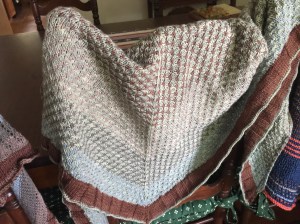 Using the mini-skeins plus a skein of pale green for the background, knitter E chose a beautifully textured pattern by Melanie Berg, A Spark of Grey. She used the mini-skeins sequentially for the textured pattern within the green background and finished the border with two of the remaining mini-skeins rather than continuing the pale green background into the border, giving it a nice contrast.
Knitter K

Using just the mini-skeins, but splitting each skein in half to create two sets of skeins, knitter K (that would be me) knit the first set sequentially and mirrored the color order with the second set of skeins. The color swaths were narrower than in knitter L’s shawl, which used full skeins, but colors were repeated. The Issa pattern by Katie White features cable like texture in the middle panel and a simple picot edge.
Knitter L

Using just the mini-skeins and ordering them sequentially, knitter L made a lovely And So Are You designed by Rose Beck. It all works together so well, the shawl features a nice texture and a pleated border; the pattern does not detract from the colors of the skeins and the colors do not detract from the stitch work. The pleats are perfect for a shawl inspired by a kilt.
Knitter P
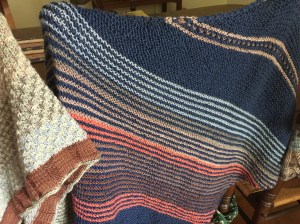
Using the mini-skeins, deep blue, and a touch of orange, knitter P also chose a Melanie Berg pattern that features frequent color changes, Drachenfels. Her touch of orange was an inspiration, a color pop that really sets off the others. She did a smart thing, brought her skeins into her LYS and worked with someone to find the perfect combination. This one was a “wow” when I first saw it, so striking and so different.
In The End
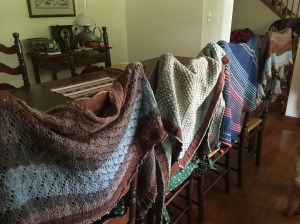
Starting with identical yarn, adding individual visions, and ending with something completely different, each project was unique and creative as the person who knit it. KALs are always so fascinating because–whatever the common thread or theme–the finished projects have so much variation. Whether it is using the same pattern, the same yarn, or even the same pattern and yarn, somehow individual knitters find ways to make it their own. The fun is in seeing all those variations and sharing the journey to the finish line.


 My favorite stage of a project is always when it is the images in my mind, imagining the what-can-be before the reality of the what-have-I-done hits followed by the inevitable coulda-shoulda-woulda regrets. For this yarn I pictured a cozy shawl in the warm colors, something to comfortingly wrap around my shoulders. Picking a pattern was a challenge in winnowing down the thousands of options; even limiting Ravelry searches to shawl, 450-600 yards range, fingering weight, and “in my favorites” resulted in pages and pages of options. I narrowed it down to shawls with texture, avoiding the lacy and delicate options as that did fit with the theme as I envisioned it. The candidates were Swan Lake by Penny Schumers, Cerasifera by Kirsten Kapur, Enticing by Jennifer Weissman, and Nutmeg by Ágnes Kutas-Keresztes. And, as things like this usually happen, I later stumbled across Issa by Katie White, a fairly simple shawl with loads of texture in a center panel. It also looked very easy to modify.
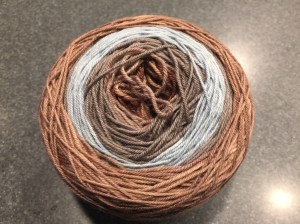 cake–whereas mini-skeins are more like stripes or swaths of color. Mini-skeins are more flexible in how the colors are mixed and ordered. Among the many options, one could do narrow stripes alternating the colors, narrow stripes of multi-colors within a main color, or wide swaths of non-repeating colors. What I decided to do was a mirror effect, so that with 5 colors I do color 1, 2, 3, 4, 5 then 5, 4, 3, 2, 1 ending with the same color I had started with. The first thing that might occur to the reader is that many mini-skein color changes means many not-so-mini ends to weave in. I was very skeptical at first, but the magic cake used in the Magic Cake Ruffle Shawl by Paula Emons-Fuessle opened up my eyes to new possibilities for joining pieces of yarn together without the chaos of spaghetti hanging off the back of the work. Her “magic cake” is made by joining multiple pieces of yarn into a single cake using a magic knot to attach them. Jane Richmond made a nice You-Tube video showing the magic knot:
 Here and There, Now and Then